
Making Sustainable Delivery Routes Feasible for Suburban Areas
How can climate-friendly urban logistics be implemented outside of dense city centers? The SuCoLo research project, led by Salzburg Research, employs pilot programs in Salzburg, Leipzig, and Merano to showcase the potential of cargo bike logistics, micro-hubs, and digital decision-making tools to enhance the sustainability and inclusivity of urban delivery routes. A free toolkit helps cities and companies implement these solutions.
Sustainable urban logistics for outlying areas
Suburban areas pose unique obstacles to urban logistics, including longer distances, lower service density, and a greater reliance on cars. Meanwhile, increasing delivery traffic causes additional emissions, congestion, and noise.
As part of the research project “SuCoLo – Fostering sustainable consumer behavior with inclusive bicycle logistics infrastructure in urban outskirts,” Salzburg Research coordinated the development and testing of new approaches to sustainable last-mile logistics. The project focused on three key components: digital demand management, flexible logistics infrastructure, and local partnerships.
Project coordinator Michael Thelen of Salzburg Research emphasizes: “Innovative solutions for urban logistics don’t just come from technology and infrastructure. Rather, close cooperation among all stakeholders is crucial. In the pilot cities, local collaboration between municipalities, logistics and courier services, retailers, and other partners has been especially important.”
Pilot project in Salzburg, Leipzig, and Merano
The project team in Salzburg worked with 1,101 participants in a simulated online store to study how digital decision-making tools could make sustainable delivery options more appealing. The results indicated that presenting sustainability metrics and information clearly can influence consumers to choose more climate-friendly delivery options.
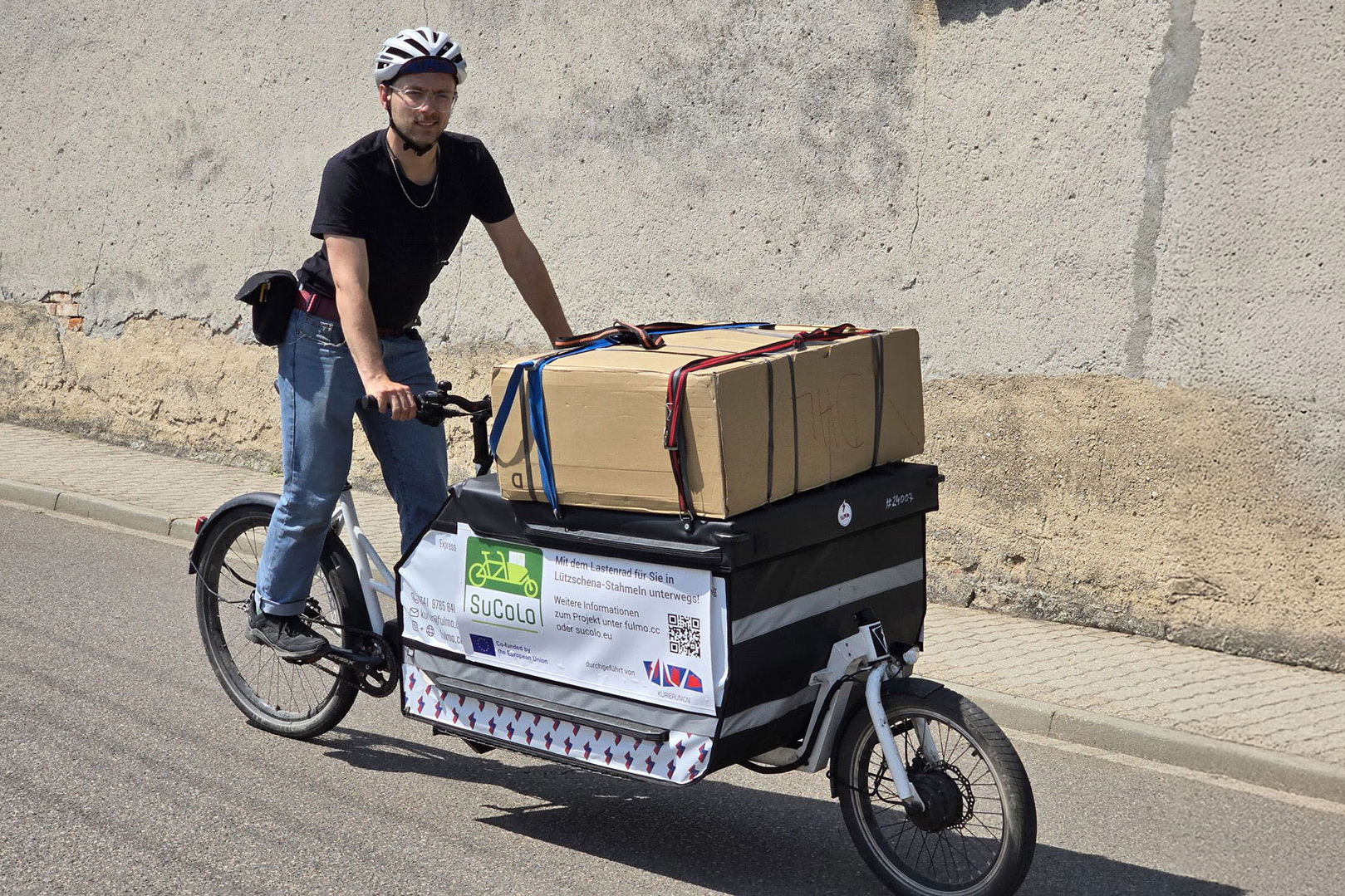
In Leipzig, the consortium tested a mobile micro-hub with cargo bike deliveries in a less densely populated area on the outskirts of the city. A total of 289 deliveries were made by cargo bike, and the option to rent a cargo bike was also available. These results demonstrate the potential of mobile hubs in outlying urban areas. However, ensuring the sustainability of these operations requires sufficient shipment volume, stable partnerships, and flexible operating models.
In Merano, the project team partnered with a local courier service to offer retailers cargo bike sharing. A key focus was accessibility. Six vehicles were used, including one designed for easy access. By April 2026, the team had made 620 deliveries, registered 120 people for the sharing services, and recruited 11 partner stores.
Cooperation and local adaptation are key to success
The results from the three pilot cities demonstrate that sustainable urban logistics in outlying areas is possible when digital incentives, flexible infrastructure, and local partnerships are in place. Reliable collaboration, sufficient shipment volume, and suitable operating models are key for long-term operation.
“At the same time, it became clear that successful approaches cannot simply be copied. Different rules, limited space, and local purchasing behavior require adjustments tailored to each city and its specific conditions,” said Michael Thelen, project coordinator at Salzburg Research.
Inclusion must also be considered from the outset. The Leipzig case study shows that needs vary depending on life circumstances. For example, older adults need short, safe routes and barrier-free access. Working-age households need reliable services along their daily routes. Younger groups benefit from fast pickup and easy digital access.
Digital prompts encourage sustainable delivery decisions
Another focus was digital nudging in online retail. This involves small digital prompts that encourage more sustainable choices without restricting freedom.
Michael Thelen, project manager at Salzburg Research, explains: “E-commerce platforms can guide their customers toward more sustainable behaviors without pressuring them. This is achieved through the intelligent design of decision-making processes. Digital nudging uses subtle digital cues to encourage desired behaviors while respecting freedom of choice.”
The tests showed that the effect depended heavily on the design. Elements that created a sense of urgency led users to stick with their standard delivery option. Transparent labels, such as a green leaf icon, loyalty points, or a default setting for a more sustainable delivery option, worked better.
Free toolkit supports cities and businesses
The SuCoLo toolkit compiles the results of the pilot projects on an interactive digital platform. The toolkit provides cities, companies, and other stakeholders with practical decision-making tools for sustainable bicycle logistics and last-mile solutions.
The toolkit includes digital planning and decision-making tools, demand management approaches, accessibility improvement instruments, and transfer and background materials. Additionally, it provides policy recommendations for sustainable urban bicycle logistics strategies. These recommendations cover strategic goals, clear responsibilities, data-driven planning, appropriate bicycle and parking infrastructure, and ways to raise awareness of sustainable delivery options.
More information:
- Projct website: https://sucolo.eu/de/
- SuCoLo-Toolkit: https://sucolo.eu/de/sucolo-toolkit/
- Press release: Nachhaltige Stadtlogistik: Praxiserprobte Lösungen für urbane Lieferwege

„SuCoLo – Fostering sustainable consumer behaviour with inclusive bicycle logistics infrastructure in urban outskirts“ was a project that ran from January 2024 to June 2026. It was coordinated by Salzburg Research Forschungsgesellschaft. The project partners were Salzburg Research Forschungsgesellschaft mbH, Fulmo Kurierunion, the South Tyrol Trade and Services Association, Independent L. ONLUS, the German Bicycle Logistics Association, the City of Gävle, the City of Leipzig, Südtiroler Transportstrukturen AG, the Sustainability InnoCenter, the University of Leipzig, and VIABIRDS Technologies GmbH. Funding for the project came from the European Union, the FFG, the MIMIT, the BMBF, and Vinnova as part of the Driving Urban Transitions Partnership.






 Certified EN ISO 9001