
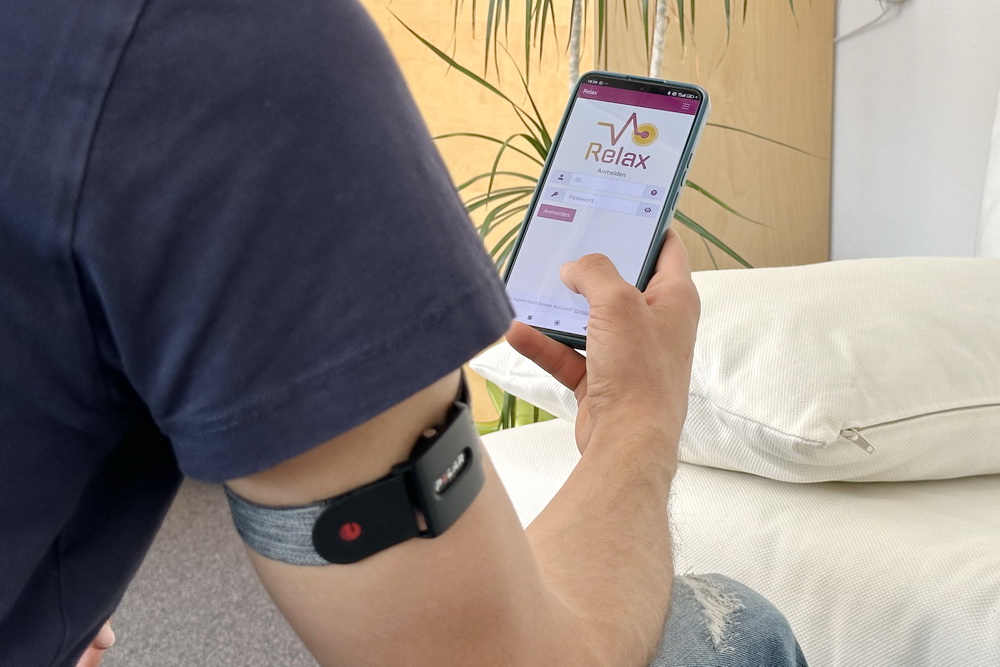
Making stress measurable in the midst of everyday life, not in a lab: Salzburg Research developed RELAX, a technical infrastructure that continuously collects, transmits, and analyzes body-worn stress data in real-life work and daily situations. For six weeks, working adults provided physiological measurement data and repeated self-reports via mobile app and connected wearables. The resulting dataset, published in Springer Nature Scientific Data, serves as a valuable foundation for research into individual stress patterns and digital interventions.
Challenge
Stress does not affect everyone the same way. Situations are perceived differently, physical reactions vary, and recovery differs from person to person. Therefore, to understand these individual stress patterns and how they interact with other areas of life, such as sleep and physical activity, it is not enough to analyze isolated snapshots or controlled laboratory situations.
We need long-term (longitudinal) data from everyday life: physiological measurements from wearables, subjective self-reports, and contextual information on work, leisure, stress, and recovery. The technical challenge lies in reliably collecting this data over several weeks, linking it chronologically, securely transmitting it, and processing it in such a way that it can be used for scientific analysis or the development of digital interventions.
Solution
Salzburg Research developed RELAX, an infrastructure that enables the continuous and reliable collection of wearable data. The Polar Verity Sense wearables were connected via the RELAX app. The app recorded heartbeats, which served as the basis for cardiac activity analyses, supplemented by motion data from integrated accelerometers. This paired smartphone app transmitted the data to the RELAX backend.
One notable technical contribution was improving the robustness of data collection in everyday use. A specially developed messaging protocol mitigated temporary connection issues between the wearable device, the smartphone, and the Internet, enabling continuous recording even when network coverage was spotty or the smartphone was not in the same room.
Additionally, the RELAX app collected subjective data on participants’ current well-being, stressful events, work and leisure situations, and physical and mental exertion several times a day. This allowed us to link objective wearable data with subjective stress experience and everyday situations over time.
This infrastructure was used to collect a longitudinal dataset of 31 individuals over a period of six weeks. This dataset includes continuous recordings of heart activity and movement, as well as repeated self-reports from work and leisure contexts.
Benefits
The published RELAX dataset provides a solid foundation for a better understanding of stress in real-life situations. It allows for the analysis of the interrelationship between subjectively percieved stress, contextual factors, and physiological patterns. The combination of continuous wearable data and repeated self-reports is particularly valuable because it allows researchers to examine periods of stress, as well as individual differences in perception, response, and recovery.
The developed infrastructure also serves as a reusable foundation for future studies, pilot projects, and digital health applications. Sensors, apps, and data analysis processes can be integrated in a structured manner, and data is made available in a timely fashion for statistical analyses and personalised AI methods.
In this way, RELAX facilitates the shift from sporadic stress measurement to ongoing, real-time, data-driven stress management. The results help identify individual stress patterns more effectively and develop personalised interventions, including adaptive recommendations that provide support at just the right moment.
Publication
Die Datensatzpublikation ist in der Fachzeitschrift Springer Nature Scientific Data erschienen:
Halmich, C., Jung, O., Schmoigl-Tonis, M. et al. A six-week longitudinal dataset of wearable and self-reported stress measurements in working adults. Sci Data (2026). https://doi.org/10.1038/s41597-026-07711-4
Learn more:
















 Certified EN ISO 9001