
AI Technologies for Climate-Friendly Cities
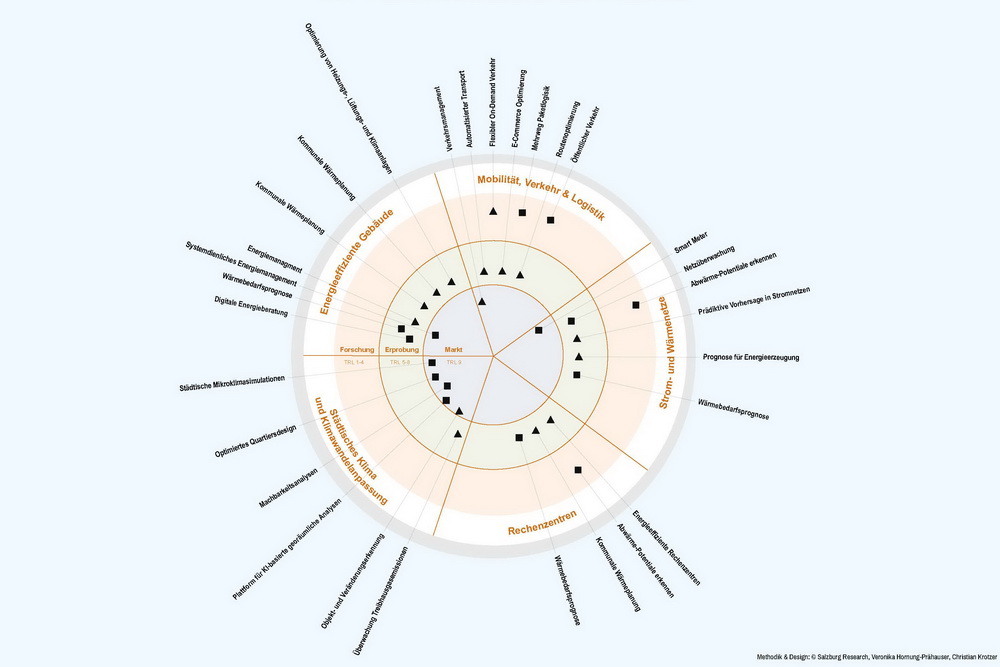
In what ways can artificial intelligence help cities and municipalities to achieve climate neutrality and adapt to climate change? The CityclimAIte study examines 29 AI solutions for municipal applications, providing decision-makers with practical guidance through an interactive technology radar.
29 AI solutions for five municipal application areas
Cities and municipalities are facing an increasing number of challenges posed by heat, heavy rainfall, and other consequences of climate change. At the same time, however, digital technologies are providing new ways to plan and manage energy, mobility, and urban infrastructure more efficiently.
The study “cityclimAIte: AI Applications for Achieving and Supporting Climate-Neutral Cities” analyzed 29 AI solutions for this purpose. The study focuses on five areas of municipal application:
- mobility and logistics
- electricity and heating networks
- energy-efficient buildings
- urban climate and climate change adaptation
- energy-efficient data centers and waste heat recovery
The applications examined were evaluated based on criteria including technological maturity, impact, feasibility, complexity and legal framework. The study therefore provides a basis for prioritising potential AI applications that can be compared.
At the same time, it shows that the effectiveness of AI’s contribution to climate goals depends on more than just the technology itself. Other key factors include the availability of high-quality data and interoperable systems, as well as the necessary expertise and a clear legal framework, such as that provided by the GDPR and the EU AI Act.
Technology radar helps with the selection process
A key outcome is the free-to-use web-based AI technology radar. This tool classifies technologies and best-practice use cases according to their technological maturity and market readiness. The radar covers three categories, ranging from research and development to pilot testing to technologies that are already available on the market. Additionally, the radar indicates the level of technical and organisational complexity.
“The Technology Radar allows you to compare AI solutions for cities. It shows at a glance which solutions are already market-ready, which are currently being tested, and where further research is needed. This allows decision-makers to set priorities transparently and plan pilot projects effectively,” said Veronika Hornung-Prähauser, an innovation researcher specialising in digital technologies at Salzburg Research.
In addition to the graphical representation, the tool provides a list view offering detailed information on individual applications. Fact sheets are available in PDF format, and the content can be filtered by criteria such as feasibility and impact.
Go to the Interactive AI Technology Radar
Study as a basis for local government decisions
The study incorporated systematic technology screening, use-case analysis, legal assessment and impact and feasibility analysis. The analysis was complemented by workshops and interviews with relevant stakeholders. The findings aim to enable decision-makers in cities and municipalities to assess the opportunities and risks of AI in the context of climate change in an evidence-based manner, and to pursue suitable applications more effectively.
The publication CityclimAIte: AI for Climate-Friendly Cities by Christian Kogler, Pia Weinlinger, Jasmin Lampert, Isabella Hinterleitner and Veronika Hornung-Prähauser was published in 2026 as part of the Reports on Energy and Environmental Research series (1/2026) by the Federal Ministry of Innovation, Mobility and Infrastructure. It is available to download for free from the AI Technology Radar website.
The study was conducted from 2024 to 2026 in collaboration with the AIT Austrian Institute of Technology, Salzburg Research and Tech Meets Legal. It was carried out on behalf of the Climate and Energy Fund and the Austrian Research Promotion Agency (FFG).
More information:
- Research projects: cityclimAIte – Studie zu KI-Anwendungen zur Erreichung und Unterstützung klimaneutraler Städte
- Publication: cityclimAIte: KI für klimaneutrale Städte
- Press release: KI für klimafreundliche Städte: Studie liefert Orientierung und macht Technologien mit interaktivem Technologieradar vergleichbar
- AI Technology Radar: https://methodenpool.salzburgresearch.at/ki-technologieradar





 Certified EN ISO 9001