
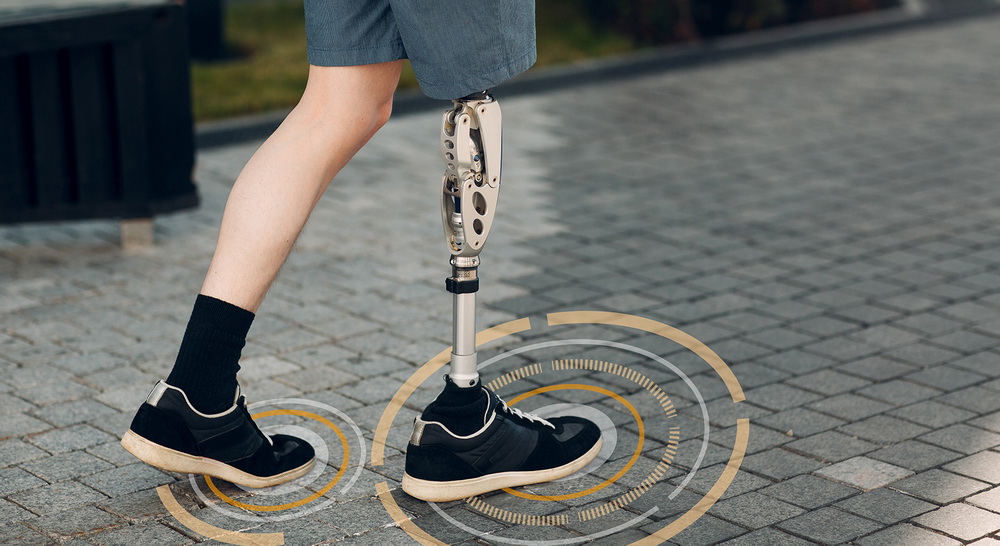
When the Prosthesis Senses the Ground
Salzburg Research is collaborating with Saphenus Medical Technology GmbH to develop a prosthesis that can detect the ground beneath it and make that information perceivable.
People who live with a prosthetic leg must be especially careful in their daily lives. It’s sometimes hard to see the ground clearly at dusk, in crowded places, or while walking and talking. Uneven surfaces, soft spots, and slopes can quickly become challenging. This is exactly where Salzburg Research comes in. In collaboration with Saphenus, they are developing a tactile prosthesis that detects the surface beneath and immediately transmits this information to the wearer.
The prosthesis is designed to support the user and sense their movements. Sensors in the foot and pressure-sensitive soles measure the load and track the movement of the prosthesis with each step. Using this data, machine learning algorithms developed by Salzburg Research identify the characteristic properties of the ground surface. The results so far are promising. The system can reliably distinguish between surfaces of varying hardness and detect slopes and steps. Transitions, such as from a firm surface like asphalt to a soft lawn, are particularly relevant because they often pose challenges for prosthesis users.
Here, what matters is not only the detection itself but also prompt feedback. There should only be a very brief moment between contact with the ground and receiving feedback. For this reason, development efforts focus on algorithms that can respond in nearly real time on energy-efficient processing units within the prosthesis itself. The detected information is translated into different vibration patterns and transmitted via small transducers to the skin, where it is perceived as a vibrotactile sensation. In addition to increased safety, users report positive effects on body awareness and relief from phantom pain.
The following video is a demonstration of real-time ground detection. It shows a sensor-equipped sole walking over various test surfaces. Meanwhile, an analysis interface displays the sensor data, pressure distribution, and currently detected ground class.

Mit dem Klick auf das Bild werden durch den mit uns gemeinsam Verantwortlichen Youtube (Google Ireland Limited) das Video abgespielt, auf Ihrem PC Skripte geladen sowie personenbezogene Daten erfasst.
In the future, vibration patterns will adapt even more precisely to different surfaces. This will allow irregularities to be conveyed more effectively. This creates an additional level of perception, allowing the ground to be felt as well as seen. The research project, aimed at expanding the human perception of prosthesis wearers, is funded as part of the COMET project “Digital Motion” by the BMIMI, the BMWET via the FFG, and the states of Salzburg, Tyrol, and Upper Austria.
More information:
- Success Story: Mobile Gait Analysis in Everyday Life for Prosthesis Users
- Research project: DiMo-NEXT – Next Level of Digital Motion in Sports, Fitness and Well-being





 Certified EN ISO 9001