

Making Energy Self-Sufficiency a Reality in Energy Communities
A recent study shows which combinations of generations, storage, and flexibility enhance supply security and explains why the concept of “100 percent self-sufficiency” is often misunderstood. In collaboration with partners, Salzburg Research provides a solid basis for decision-making in this area.
Clearly distinguish between different concepts of self-sufficiency
Energy communities are gaining prominence at a rapid rate in Austria. Many stakeholders expect an independent energy supply. However, a study by Salzburg Research and its partners suggests that this expectation should be treated with caution.
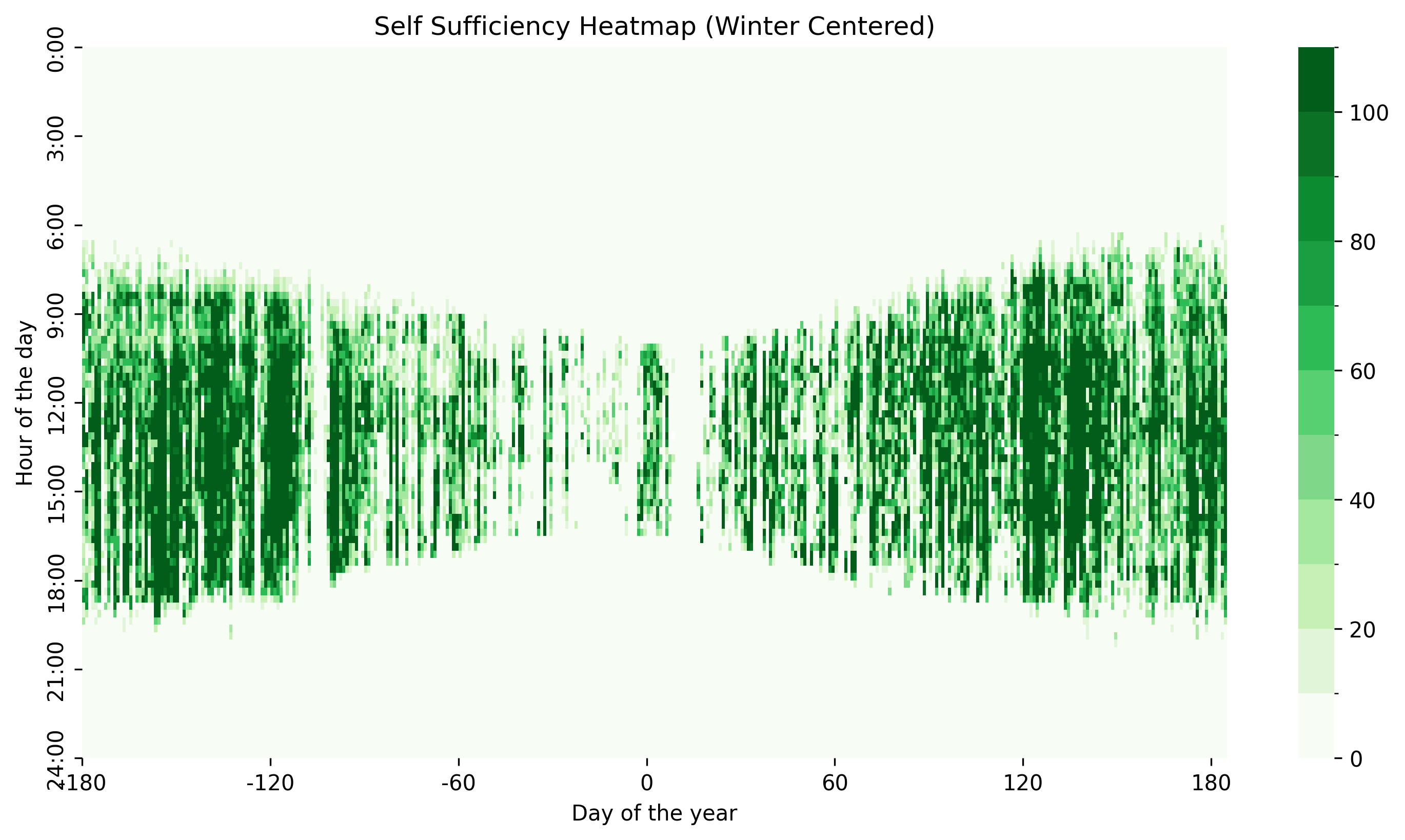
The analysis distinguishes between “balance-sheet self-sufficiency” and “load-based self-sufficiency.” The former aims to achieve a balanced annual energy supply, while the latter describes the ability to meet energy demand at all times through self-generation. A key challenge becomes apparent here: in Central Europe, a significant winter gap emerges because photovoltaic systems generate less energy while demand for heating rises.
“A detailed analysis reveals a significant winter gap caused by the mismatch between photovoltaic (PV) generation and seasonal heating demand,” says Stefan Linecker, a researcher at Salzburg Research and the study’s lead author.
Systemic solutions enhance the security of supply
As part of the Autarkity research project, Salzburg Research worked with partners to create realistic energy community scenarios. The study examined, among other things, a municipality-led community comprising 230 metering points.
The results show that individual measures are insufficient. In the reference scenario, a purely electrical analysis yielded a self-sufficiency rate of 26 persent, whereas the overall self-sufficiency rate, including heating and transportation, reached only 4.2 persent.
Significant improvements are primarily the result of the interaction of several technologies:
- Battery storage systems are gradually increasing self-consumption
- Additional solar power generates diminishing returns from surplus electricity
- Continuous generation, such as from hydropower, stabilizes the supply
- Optimized PV orientations improve coverage of peak loads
A cross-sectoral perspective is also crucial. While the self-sufficiency rate for electricity may decrease when electricity is used for heating and transportation, the overall balance improves due to the replacement of fossil fuels.
“A decline in electricity self-sufficiency rates, when coupled with sector coupling, does not indicate failure, but rather suggests that fossil fuels are being effectively replaced,” said Linecker.
Costs and benefits determine acceptance
In addition to technical analysis, Salzburg Research examined consumers’ willingness to pay for self-sufficiency measures. The results suggest that consumers are highly price-sensitive.
Well-established technologies such as photovoltaics, wind power, and battery storage are particularly well-received. More complex and costly solutions, such as hydrogen systems, are viewed much more critically. It is crucial that they offer a clearly recognizable added benefit, particularly in the form of a noticeable improvement in supply security.
Self-sufficiency as an interdisciplinary design challenge
The study does not view self-sufficiency as a purely technical goal, but rather as a combination of technological solutions, economic viability, and social acceptance. This means that successful energy communities require integrated strategies and clearly defined objectives, and this message is intended for municipalities, government agencies, and the business community.
“Self-sufficiency is therefore less of a technical optimization problem and more of an interdisciplinary field encompassing technology, economic viability, and social acceptance,” Linecker summarizes.
Manual and roadmap available online
The results were presented at the 19th Energy Innovation Symposium in Graz. The Autarkity Handbook & Roadmap is available online and provides practical advice on setting up resilient energy communities.
Publications:
- Stefan Linecker, Peter Dorfinger, Guntram Pressmair, Martin Mayr, Andreas Werner, Seyyed Joneid Hasannejad, Christian Pfeiffer, Patricia Jasek, Karina Medwenitsch, Lukas Plessing, Michael Ruthensteiner (2026): Autarkie in Energiegemeinschaften: Erwartungen, Machbarkeit und Hindernisse In: Conference Proceedings, 19. Symposium Energieinnovation (EnInnov 2026)
- Patricia Jasek, Stefan Linecker, Peter Dorfinger, Guntram Pressmair, Martin Mayr, Andreas Werner, Seyyed Joneid Hasannejad, Christian Pfeiffer, Karina Medwenitsch, Lukas Plessing, Michael Ruthensteiner (2026): Autarkity Handbuch & Roadmap
The study was conducted as part of the Autarkity project (project number 921047) and was funded by the Austrian Research Promotion Agency (FFG). Additional funding was provided by the Clean Energy Transition Partnership through the RENvolveIT project (project number 915906), which is co-financed by the European Commission (grant agreement no. 101069750).
More information:






 Certified EN ISO 9001