Posts filed under 'Innovation'

I just bought myself a USB DVB-T device (eyeTV from elgato systems for OS X). My motivation is that we are organising the “Medientag Salzburg” on 17 October 2006 and that the region of Salzburg will start with DVB-T(errestrial) on 26 October 2006.
See also the following links:
The device (and the corresponding software) worked extremly well, I could watch ORF 1 and 2 (with the regional identities “Salzburg” and “Upper Austria”) and ATV. That was in the afternoon. Now (at 20:30 in the evening) it does not seem to work any more (“no signal”)… Anyway, it’s almost two months before the official start.
August 31st, 2006

There are several working groups within the Alpbach technology forum. I participated in one on “Technology Transfer: the Motor for Developing Locations” (Arbeitskreis 2). Erich KNY was the main organiser of the working group.
Participants were:
- Erich GORNIK from ARC Seibersdorf
- Gernot GRIMM from the Federal Ministry for Transport, Innovation and Technology, Vienna
- Werner HOFFMANN, Chairman of the Board, Contrast Management-Consulting GmbH, Vienna
- Wolfgang PÖHL consultant for ITG-Salzburg
- Franz STAUDACHER from Westcam Projektmanagement GmbH, Mils
- Helmut SCHÜHSLER from TVM Capital GmbH, Munich
- Sylvia ROHR from Steinbeis-Stiftung für Wirtschaftsförderung, Stuttgart
- Doris AGNETER from tecnet capital GmbH, St. Pölten
- Otto PROHASKA OttoConsulting, LLC, USA
An excellent workshop, I liked most the value-chain-like introduction by Erich Gornik; and, Sylvia Rohr from Steinbeis had very dense but excellent slides on the issues of tech-transfer (btw: Steinbeis has zero basic financing, that is impressive).
August 27th, 2006
At the second day of the symposium, there was a workshop on research management (actually it was more a mini-conference than a workshop). Susanne Herlitschka was the organiser (and she gave herself an excellent presentation on the medical university of Graz.
Mag. Binder presented “governance in FTI policy. He presented some figures on R&D spending in Austria (2005).
| Industry |
46% |
| Government (“Bund”) |
30% |
| Foreign investments |
17% |
| Local governments (“Länder”) |
6% |
| Others |
1% |
| Total is 6 Bill. EUR |
100% |
Binder also mentioned that in the last 10 years, an evaluation culture has emerged in Austria. That is true, actually, I believe we are doing too many (or in a too short sequence) evaluations these days: if you think of competence centres, then the initial proposal is evaluated; you have an intermediate evaluation after 1.5 – 2 years already; another one after 4 years. As we all know, this is a substantial effort. I personally believe we are over target there.
Mag. Neurath then did an excellent presentation from the perspective of the Austrian Research Council. He also argued for a kind of “trial/testing” way of establishing research policy. His argument was that this would make room for new ideas/creativity. I have to say that I am personally not convinced by this approach: as a researcher (depending on public funding and research programmes), I have had some (too many?) experiences with not well designed/targeted programmes that cause a lot of headache. Once these programmes are up and in shape, I would not change them simply for reasons of “bringing in new ideas”.
June 29th, 2006
Today and tomorrow, I am participating in an ITG organised event around the theme “innovation and/through creativity”. The symposium is called “Kreativität: Impuls für Innovation”.
The symposium was opened by DDr. Sebastian Huber, director of ITG-Salzburg.
Then, Dr. Wilfried Haslauer, Landeshauptmann-Stv., argued that especially in mid-Europe within the last 20 years with the fall of the wall we have increased (world-wide) competition and that therefore “uniqueness” is ever more important. Creativity and design could be factors that allow high-quality products to be unique.
Gudrun Mosler-Törnström, Stv. Landtagspräsidentin, argued about research and innovation. She mentioned Salzburg’s competence centers “NewMediaLab” and “ANET-Salzburg” (coordinated by Salzburg Research), the University of Salzburg (incl. a professorship on structural biology lead by Prof. Brandstetter) and a new study course on engineering (starting this fall) in cooperation with the Technical University of Munich.
Dr. Helene Karmasin, from Karmasin Motivforschung presented innovation from a customers’ perspective. She had some excellent points in her presentation.
Firstly, she argued that in science and art, we are used to measure in visibility, fame, etc. On the market, the only thing that counts is sells, i.e., creativity and innovation are important; however, there is quite a number of examples where award winning innovations failed on the market.
Also, she discussed what we actually mean by “new”. Often, “new” is about new (and yet unknown) combinations. E.g., byuing wine at a petrol station is (was!) new simply by selling existing products (wine) at a different place.
There was an argument that small, open economies (SMOPECs) such as Austria need to be creative and innovative because they have very few natural resources.
Mag. Monika Kircher-Kohl CFO from Infineon presented Infinfeon’s innovation process (“Der Innovationsprozess bei Infineon”). A key component at Infineon is human resources development, she talked about life long learning and the fact that one should “let people grow” and “encourage and challenge” rather than “carry”.
DI Wolfgang Anzengruber, CEO of Palfinger AG, talked about innovation processes at Palfinger. He mentioned huge improvements in the production process by which (internally) you get more capacity; also, dealers need to hold less stock; and finally, customers get their goods quicker.
Overall, I would agree that the combination of high-quality products with good (creative) design is key to Europe’s/Austria’s/Salzburg’s competitiveness. From a researcher’s perspective, I think we (as researchers) contribute curiosity and a sound methodological approach.
June 28th, 2006
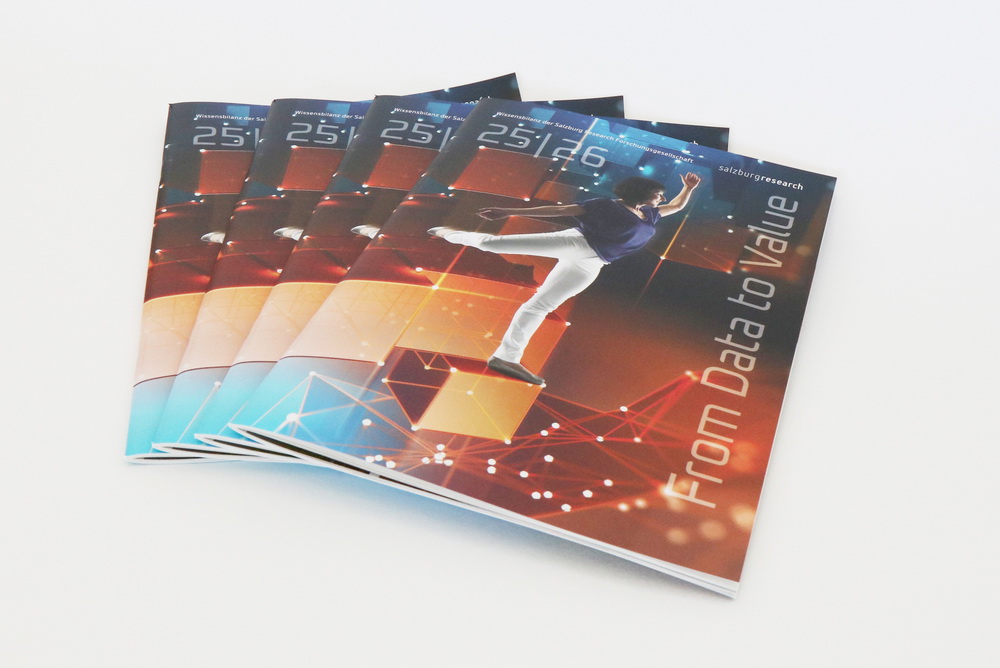
Salzburg Research has just published its annual report. As for all non-commercial organisations, the real asset of institutions such as Salzburg Research lies in its Intellectual Capital; therefore, we publish an intellectual capital report (“Wissensbilanz”) as part of our annual report (since 2002, btw).
Originally, in 1994 Skandia AFS published a supplement to its annual report about talking about “hidden values in Skandia” (see the document Visualizing Intellectual Capital in Skandia).
ARC Seibersdorf and its former head of research, Günther Koch, have definitely promoted ICRs in Austria, see for instance a presentation to the World Bank entitled “IntellectualCapital Reporting (ICR) (“Wissensbilanz”) – Made in Austria”.
Stefan Weiß, Futurelab, discusses the (German) term “Wissensbilanz” and argues that it is misleading, as it does not distinguish between assets and liabilities (like a typical balance sheet does, see a blog entry on ICR vs. Wissensbilanz).
From our experience, I would argue that the core issues of ICRs include
- the definition of terms
- the methodology and process of generating the ICR, and
- the way to influence the indicators (because almost all indicators can only be influenced with indirect means)
A general terminology would be useful for monitoring and moreover benchmarking between organisations – Koch discusses some of the differences concerning the structuring of categories of intangible capital in major models in the presentation mentioned above.
The Fraunhofer-Institut für Produktionsanlagen und Konstruktionstechnik (IPK)has established a working group on promoting ICRs.
Daniela Gröbel/ Klaus North/ Günther Szogs provide a comparison of four different approaches.
May 18th, 2006
Next Posts